Activity is mistaken for outcome.
Calls, tokens and draft volume say little about whether work is correct, usable, authorised or worth the effort required to review it. Start with the quality contract for the workflow.
Scattered AI tools and subscriptions leave businesses piecing together context, costs and decisions. Synaporia is designed to bring that work into one governed business platform: useful intelligence, calibrated judgement, accountable action and evidence people can inspect.
Development-stage software. The interactive console demonstration uses synthetic data; customer pilot and production use remain blocked.
AI value is lost when organisations count activity but omit review, correction, failure and escalation. Five connected problems separate a fluent draft from a governed business outcome.
Calls, tokens and draft volume say little about whether work is correct, usable, authorised or worth the effort required to review it. Start with the quality contract for the workflow.
A quick draft can create slower verification, correction and escalation. That human review tax belongs in the value calculation, alongside the apparent speed of generation.
Evidence may be missing, contradictory, stale or outside the task a model and procedure were qualified to handle. Clarification, abstention and escalation can be the right next step.
Generated text must not grant access, approve a case or authorise a consequential effect. Business rules, permissions and named people retain authority outside the model.
A provider response alone cannot show which context, policy, evidence, procedure, approval and outcome governed the work. Keep the request and the observed result connected.
Useful intelligence, calibrated judgement, business control and reviewable evidence belong together. This is the product’s design proposition; the current console and deployment boundaries are shown separately below.
The intended operating model combines an eligible model, procedure, evidence set and resource budget. Quality comes before output volume; provider choice is a means to useful work.
Distinguish a usable answer from work that must clarify, abstain, escalate or stop. Model confidence alone does not establish that the evidence is sufficient.
Bind data, tools, spend and action to organisational policy and named authority. A proposed plan, an approval and a confirmed external effect remain different things.
Reconstruct what was proposed, allowed, approved, attempted and observed. Keep accepted artifacts, uncertain effects and unfinished business obligations distinct.
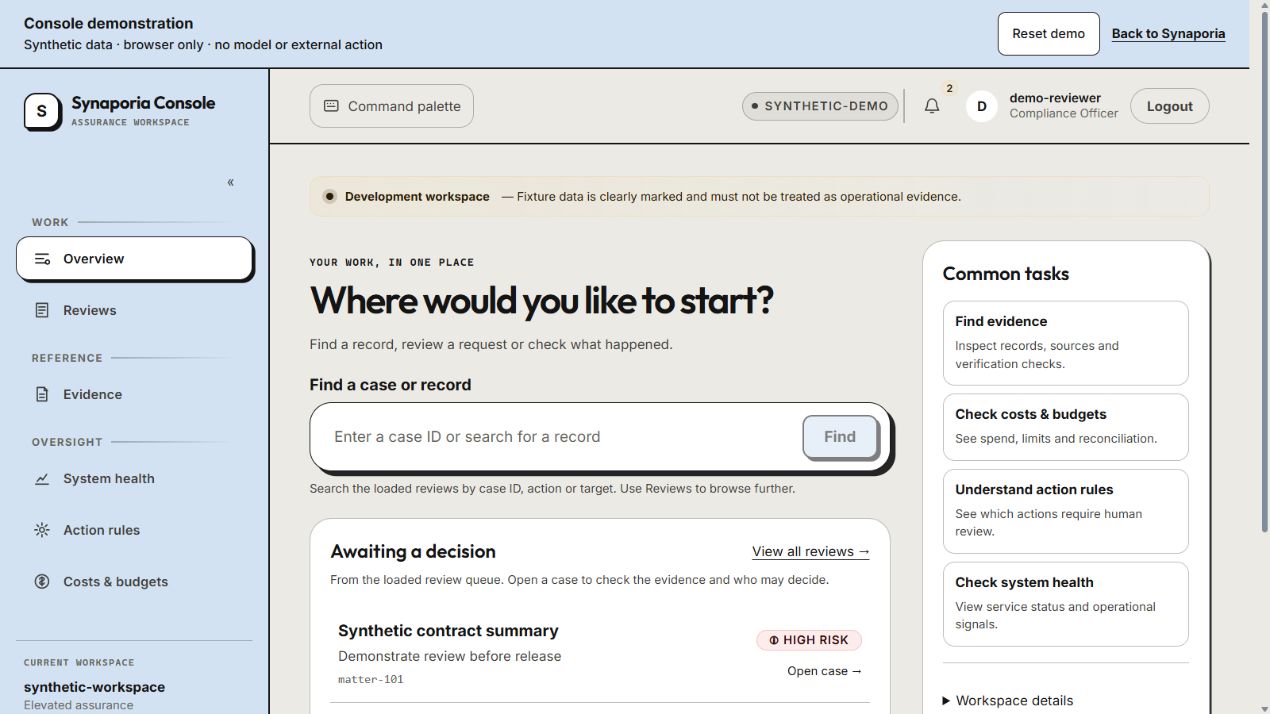
The current workspace supports deterministic navigation and retrieval, alongside a governed submission path that refuses unqualified model calls. Open the underlying case or record rather than treating a conversation as the system of record.
Review proposals, approvals and the evidence attached to them. Current case-owned views distinguish unresolved work and support scoped correction and reopening. Integrity checks do not establish that every factual assertion is true.
Six console views cover spend, cost exploration, unit economics, budgets, reconciliation and price books. The demonstration labels example amounts and withholds unmeasured economics rather than inventing savings.
Record the objective, relevant source material and gaps. Quotation matching and declared citation support must not be mistaken for semantic verification.
A named reviewer considers the work against its criteria. Approval is scoped to the action and current authority; an authenticated report can still contain a false assertion.
A request, a receipt and a completed obligation are separate records. Unknown outcomes need reconciliation before retry. Live external-effect guarantees still require qualification.
The same business may need a light path for public creative work and stronger review for a consequential action. Control intensity follows the operation; it is not a slider for model intelligence.
Move quickly
Public, non-sensitive, low-impact work with no privileged external effect.
Bounded content and resources
Ground the answer
Ordinary internal work and bounded read-only assistance.
Authenticated context; sources when required
Protect sensitive work
Confidential or personal context and customer-specific answers.
Least disclosure; grounding; required confirmation
Support accountable judgement
Legal, financial, HR or other work with material consequences.
Evidence; independent challenge; named authority
Stop unsafe progression
Irreversible, safety-relevant or very high-value work.
Stronger independent review; required dual control; stop on material disagreement
Context is authoritative. Tenant policy, legal duties, data classification, identity, requested effect and state freshness can raise the required control. A user or model cannot lower an authoritative floor. These tiers describe control requirements, not five currently available production plans. Compare the trust boundaries →
Quality, judgement, control and evidence create business value only when API, cost, data, security, reliability and integration boundaries work together.
Account for provider input and output, cached context, tools, retrieval, retries, human review, correction, escalation and operations. A lower token bill does not by itself establish a cheaper accepted outcome.
Models and APIs differ in capability, structured output, retention, residency, caching, quotas and failure semantics. The design uses versioned provider eligibility and policy-aware routing rather than assuming every model is interchangeable.
Carry the right business context with its purpose, sensitivity, source authority and lifecycle. Local memory retirement and projection withdrawal have implementation evidence; external deletion and backup propagation remain open.
Retrieved text cannot grant authority. Credentials belong outside the model, generated tool arguments require authorisation, and privileged work needs the controls required by its assurance profile.
Timeouts, duplicate delivery, stale state and partial results can turn a correct proposal into an incorrect business effect. Durable intent, bounded retries and reconciliation are part of the operating design.
Identity, matters, cases, projects, ledgers, approvals and records of truth keep their owners. MCP, REST and customer-cloud delivery are additive channels with specific coverage—not a parallel AI authority store.
These are design and locally implemented component boundaries, not a qualified customer deployment. Provider profiles, remote adapters, invoice reconciliation and complete operating environments still require evidence. Explore the operating model →
The target experience should hide platform engineering complexity while each business keeps ownership of its policies, approvals and acceptable use.
Start with approved public information and a clear hand-off boundary. Qualify the useful task before expanding sources or permissions.
Public drafting can use a simpler eligible procedure with content and cost limits. Consequential publication still has its own authority boundary.
Model neutrality does not require unnecessary switching. Choose the eligible provider configuration and work procedure that suit the context.
A bounded low-risk path should avoid unnecessary work. Required safeguards and measured deadlines still constrain any fast path.
Evaluate managed or customer-controlled delivery against the workflow’s privacy, integration and assurance requirements. Deployment options remain subject to qualification.
Legal, financial, HR and safety-relevant work may need independent challenge, explicit approval and recovery plans before a protected effect.
These are intended customer journeys, not current production offers or delivery-time promises. Today’s next step remains architecture discussion and controlled synthetic evaluation.
Current console surfaces, policy and evidence components, and specific governed compositions have repository evidence.
Deployed authority adapters, independent execution/signing, remote-effect guarantees and complete customer environments remain open.
Scope a workflow and explore synthetic examples. No production subscription, guaranteed SLA or certification is represented.
Record the answers before enabling a business workflow.
Public thought-leadership drafting may use Rapid; confidential matter research may require Protected. A consequential recommendation may require Governed, while a high-value irreversible action may require Critical. HR work stays separate from client matters.
Legal research, matter management, HR operations, finance controls, project delivery and communications bring different sources, authorities and review needs. Versioned workflow and business-function rules add those requirements to the operation.
Composition has local repository evidence. Complete customer DMS, HRIS, finance, CRM, calendar, messaging and payment integrations are not represented as qualified. See how context and authority compose →
Define the business objective, acceptable outcomes, prohibited actions, authoritative systems and review effort. Compare the proposed workflow with its simpler baseline before making cost or accuracy claims.
Tell us about the outcome, the review process and the systems involved. Use non-sensitive examples; please do not include customer records, credentials or confidential material.
We use contact details you send to respond to your enquiry. Website and enquiry privacy.